



Ask an Expert: Secret Tricks for the Perfect Cushion Arrangement
An interior designer’s guide to choosing and arranging cushions all over your home

There’s something about the cosiness of soft furnishings – pillows and cushions in particular – that I’ve always had a very strong love affair with. So make no mistake, when it comes to saying no to beautiful cushions, I’m not the expert. However, there are some secret tricks I share with clients when they ask what’s the best way for them to arrange their cushions and how many they should choose.
The truth is, we all know which cushions we like, but knowing how to choose the correct ones for your space and how to arrange them when you get home is a bit trickier – and to be honest, it’s more of an art than a science. Below are some of the most common questions I get asked and my tried-and-tested response to each.
The truth is, we all know which cushions we like, but knowing how to choose the correct ones for your space and how to arrange them when you get home is a bit trickier – and to be honest, it’s more of an art than a science. Below are some of the most common questions I get asked and my tried-and-tested response to each.

What’s inside?
The filling in your cushions will determine how squishy they are. The most common filling for inexpensive cushions is foam or synthetic wadding. This filling tends to be firm and helps cushions hold their shape, but they don’t look overly inviting.
Natural fillings such as feather and down make for a much plusher, more squishy cushion that can have its shape plumped up a lot more than a cushion with a synthetic filling. Natural fillings do cost more, though, but may be worth the investment, as they last longer than foam and you can simply change the cushion cover whenever you fancy an update. My suggestion to clients, however, is to consider a combination of an inner foam core with a natural feather or down wrap.

To chop or not to chop?
Have you heard about cushion chopping? You can rest assured I’m not referring to cutting your cushions up into small pieces (which would be a sin in my book) – rather, I’m describing a way of shaping your cushions to make them look more inviting and less rigid. See the V-shaped dent in the cushions pictured here? They have been ‘chopped’.
To achieve this look, first plump up your cushions, then, using a karate-chop motion with the side of your hand, create an indent in the centre of the top edge of your cushion. This works best with feather- and down-filled cushions as their shape is more easily manipulated than those with a synthetic fill.

Are cushions necessary at all?
My husband would argue that cushions are completely gratuitous and, in a way, I can’t argue with him. They are unnecessary in the sense that they don’t serve much of a purpose other than looking pretty and making a space feel cosy – but for me that’s reason enough to fill my home with them.
Take the bed, for example. Stacked up against pillows on a well-made bed, cushions really don’t serve any useful purpose other than looking good. They get removed from the bed every night before we tuck ourselves in. But I’m sure that when they are artfully arranged, the display is a powerful but subliminal enticement, beckoning us to get into bed and go to sleep.
On a sofa, cushions do serve some purpose other than their prettiness. They can add to the comfort and give you somewhere to rest your head when you have a Sunday afternoon nap. You generally won’t want to remove cushions from a sofa in order to sit on it, but don’t add too many. If there is no visible seat left, then you may have gone a cushion too far. Less is more!

How many cushions are too many on a bed?
Now that’s the million dollar question, and there’s really no correct answer, I’m afraid. I use a ratio of 2:2:1 (that’s only five) to order the placement of cushions on a bed.
Start off with two cushions of the same size and colour at the back, arrange two smaller cushions, maybe in a complementary colour ,in front of the first two, and then finally place one smaller accent cushion at the very front. You may be particularly attracted to this arrangement if you like things to look symmetrical and organised.
Just make sure you have a big basket to throw your cushions into when getting into bed – you don’t want to stumble over them during the night.

How many cushions are too many on a sofa?
The same 2:2:1 ratio can be used for arranging cushions on a sofa. In this case, start from the outside and work your way in. Place your two largest, matching cushions on the outer edges of the sofa resting against the arms. Then place the next two matching cushions overlapping the two outer ones, not completely in front of them, as pictured here. Finally, finish off with a single accent cushion in the centre.
The cushions don’t have to be different sizes, as you won’t be placing them directly one in front of the other. However, it creates more visual interest if the sizes vary as opposed to all being the same. They don’t even have to be different colours – it depends on the look you’re after and how much colour you want to introduce.

Are there less formal arrangements?
For a more relaxed look, try grouping your cushions to one side of your sofa instead of arranging them symmetrically on either end.
Work in odd numbers – groups of three or five cushions are much more visually pleasing than when they are grouped in even numbers. Odd numbers are less formal and more relaxed, and are often preferred in some Asian cultures. In Japan, for example, traditional homeware items, such as bowls, are sold in sets of five.
Even numbers work well in formal arrangements, as it gives a more organised and anchored feeling to the scheme.

Which colours should I choose?
First and foremost, consider the colour of the sofa you are putting your cushions on, or the bed linen on which they will sit, to make sure the whole scheme will work well together.
Surprisingly, an arrangement of cushions that are all various tones of the same colour as the bed or sofa they sit on, as pictured here, can look just as striking as a combination of different-coloured cushions. The tone-on-tone colour scheme is very soothing; it creates an air of elegance and sophistication.
Be inspired by these 10 ways to spruce up your neutrals

How do I use brights?
If you want to add some vivid colour to your bed or sofa, consider choosing cushions in complementary colours. In this picture, a plain white couch is made cheery by the addition of a colourful throw and some complementary cushions. Blue is a complementary colour to orangey yellow, and the black and white creates an extra element of dramatic visual interest. The contrast between solid colour, geometric shapes and delicate floral patterns creates a visually striking look.
If you want to add some vivid colour to your bed or sofa, consider choosing cushions in complementary colours. In this picture, a plain white couch is made cheery by the addition of a colourful throw and some complementary cushions. Blue is a complementary colour to orangey yellow, and the black and white creates an extra element of dramatic visual interest. The contrast between solid colour, geometric shapes and delicate floral patterns creates a visually striking look.

What about texture and pattern?
Add interest by choosing cushions that have different textures, such as a wool-knit cushion teamed with a smooth cotton one, or a fake fur cushion paired with a plain linen design. You can also introduce subtle contrast by choosing one shade and then mixing solid-colour cushions with ones that sport a smart pattern.
Add interest by choosing cushions that have different textures, such as a wool-knit cushion teamed with a smooth cotton one, or a fake fur cushion paired with a plain linen design. You can also introduce subtle contrast by choosing one shade and then mixing solid-colour cushions with ones that sport a smart pattern.

How relaxed can the arrangement be?
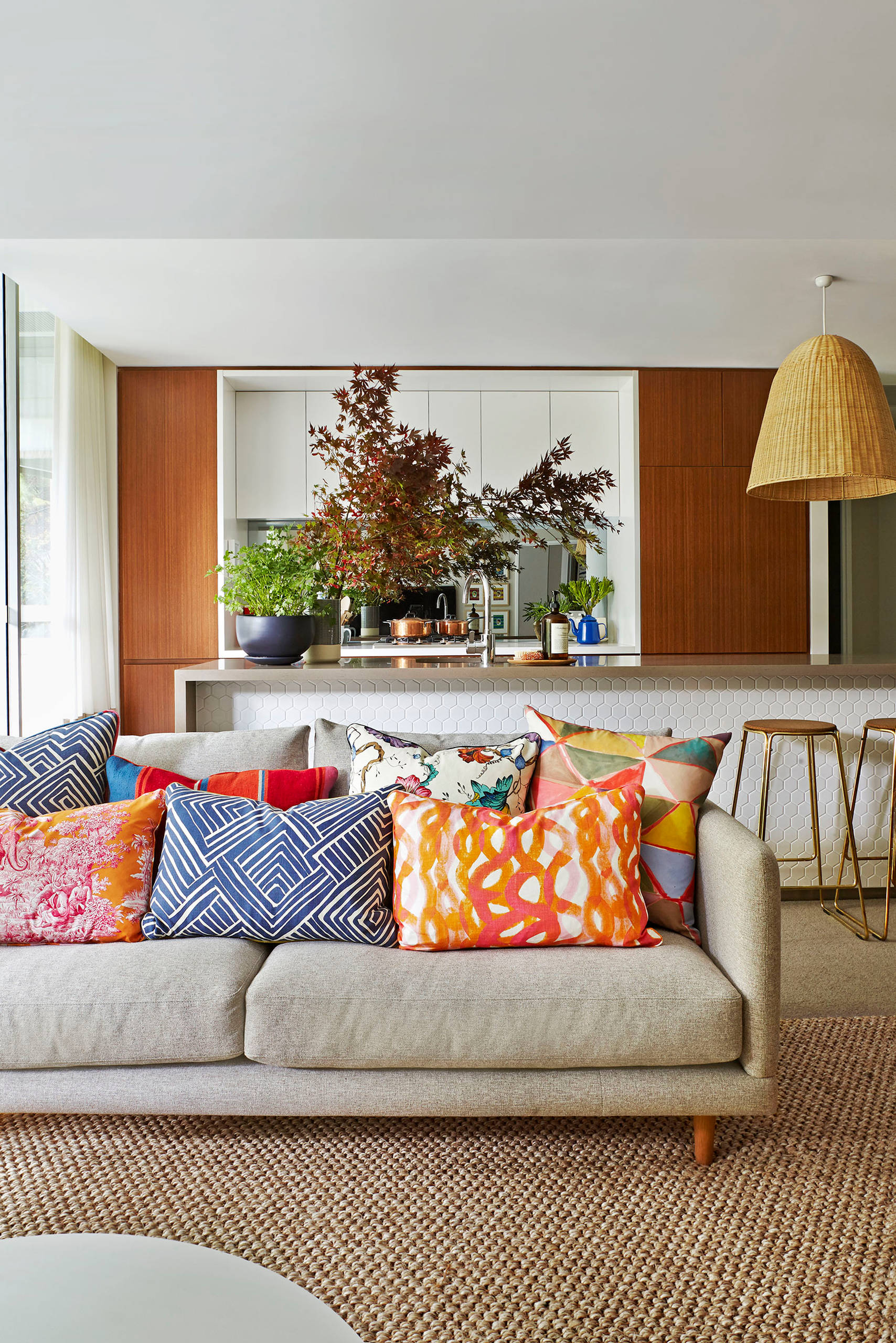
Don’t be afraid to toss your cushions about a bit – they don’t have to be perfectly plumped and standing to attention, especially when they are gracing a low-profile sofa, as pictured here. The cushions appear to be haphazardly placed, but this is what makes it work so well in this space. It feels relaxed and inviting.
However, while the cushions may feel casually arranged, there has been thought and planning put into their placement. On closer inspection, you will notice that the ‘working from the outside in’ rule has pretty much been followed. Also, the colours of the cushions have been carefully chosen to ensure they will work well together. They also tie in other elements of the room’s décor, such as the artwork and other coloured accessories in the space.
See how you can make a statement with a bold artistic rug

TELL US…
Are you a cushion fan? How many do you think are too many? Show us a picture of one of your favourite arrangements in the Comments below.
Are you a cushion fan? How many do you think are too many? Show us a picture of one of your favourite arrangements in the Comments below.

Sponsored
Reload the page to not see this specific ad anymore
There are no hard and fast rules when it comes to arranging cushions: it’s often a case of trial and error. My method usually involves arranging the cushions as I think they work on the sofa, and that includes standing back to get a sense of how they work within the context of the whole room and its general style. I suppose I just ‘sense’ how to do it.
However, clients often ask me to explain how I do it. They want to know what’s the best way for them to arrange their cushions and how many they should choose. To answer them, I’ve come up with some guidelines and shared them here to help get you started with your perfect cushion arrangement.
Find your perfect cushion in the Houzz Shop