

How to Choose a Bathroom Vanity Unit
A basin/storage hybrid is often more than the sum of its parts: plan it well and it can be both functional and beautiful

Vanity units are the backbone of bathroom design. Not only are they important on a functional level for providing storage and piped water at washstand height, they’re often the standout item in the room, too.
As part of our Bathroom Planning guide, here’s how to choose or design a vanity unit that repays your efforts and works hard for your money.
Professional advice from: Jane Ive of Bathroom Design Studio; Saima Siddique of Sai Interiors; Philippa Richard of Ace Your Space; Cat Hoad of Absolute Project Management
More in this series: How to Choose a… Shower; Shower Head; Shower Tray; Shower Enclosure; Bath Material; Basin Tap
Starting your bathroom project? Read How to Plan for a Bathroom Renovation
As part of our Bathroom Planning guide, here’s how to choose or design a vanity unit that repays your efforts and works hard for your money.
Professional advice from: Jane Ive of Bathroom Design Studio; Saima Siddique of Sai Interiors; Philippa Richard of Ace Your Space; Cat Hoad of Absolute Project Management
More in this series: How to Choose a… Shower; Shower Head; Shower Tray; Shower Enclosure; Bath Material; Basin Tap
Starting your bathroom project? Read How to Plan for a Bathroom Renovation
What’s best for storage – drawers, shelves or cupboards?
Jane points to the recent rethink in kitchen design, with its preference for drawer units over cupboard or shelf options. “In bathrooms, full-width drawers can suit smaller vanity units,” she says. “Alternatively, go for lots of smaller drawers in a bigger unit.”
Some vanity ranges have a deep drawer at the bottom for heavier or bulkier items and one or two shallow drawers at the top so you can store items lying down.
“Be aware that bigger items, such as toiletries, can fall over when you pull out a larger drawer, so sometimes cupboards or shelves might be better,” Jane says. “I prefer a mix of drawers and cupboards and encourage my clients to make a choice depending on the specific items they want to store.
“Look for dividers and inserts to split up the storage space and keep things in their place,” she continues. “Hanging racks that hold toiletry bags and compact shelving on the inside of doors are other useful innovations.”
To see more from any of the designers whose photos are featured in this article, click on the image, then on Learn More if you’re in the app, and follow the links to the professional’s profile.
Jane points to the recent rethink in kitchen design, with its preference for drawer units over cupboard or shelf options. “In bathrooms, full-width drawers can suit smaller vanity units,” she says. “Alternatively, go for lots of smaller drawers in a bigger unit.”
Some vanity ranges have a deep drawer at the bottom for heavier or bulkier items and one or two shallow drawers at the top so you can store items lying down.
“Be aware that bigger items, such as toiletries, can fall over when you pull out a larger drawer, so sometimes cupboards or shelves might be better,” Jane says. “I prefer a mix of drawers and cupboards and encourage my clients to make a choice depending on the specific items they want to store.
“Look for dividers and inserts to split up the storage space and keep things in their place,” she continues. “Hanging racks that hold toiletry bags and compact shelving on the inside of doors are other useful innovations.”
To see more from any of the designers whose photos are featured in this article, click on the image, then on Learn More if you’re in the app, and follow the links to the professional’s profile.
How do I choose a design for a small bathroom?
Philippa recommends working with the shape of your bathroom to maximise space where its available. “In reality, bathrooms might only be small in one direction – long and narrow, for example – but many space-saving basins are small in both width and projection,” she says.
“If the space is long and narrow, you can create a greater feeling of space and luxury by having a very wide basin area, but one that doesn’t project too far into the room,” she says. “Similarly, if the width is restricted, go for a bit more projection.”
“Our shower room is not huge, but the long, trough-shaped basin allows my daughters to both use it at the same time,” she continues. “A normal basin would have projected too far into the room and would only have served one girl at a time.”
Philippa also recommends a curved design in a small space. “If you have to walk past it, then a curved front will make it easier to pass and is less likely to cause ‘ouch’ moments than some sleek, angular structure,” she says. “Push-to-open doors or drawers are also a good idea, so there are no knobs or handles [sticking out].”
Philippa recommends working with the shape of your bathroom to maximise space where its available. “In reality, bathrooms might only be small in one direction – long and narrow, for example – but many space-saving basins are small in both width and projection,” she says.
“If the space is long and narrow, you can create a greater feeling of space and luxury by having a very wide basin area, but one that doesn’t project too far into the room,” she says. “Similarly, if the width is restricted, go for a bit more projection.”
“Our shower room is not huge, but the long, trough-shaped basin allows my daughters to both use it at the same time,” she continues. “A normal basin would have projected too far into the room and would only have served one girl at a time.”
Philippa also recommends a curved design in a small space. “If you have to walk past it, then a curved front will make it easier to pass and is less likely to cause ‘ouch’ moments than some sleek, angular structure,” she says. “Push-to-open doors or drawers are also a good idea, so there are no knobs or handles [sticking out].”
How do I ensure my vanity unit is ergonomic?
“Many vanity units are too low,” Philippa says. “I found some research that showed basins should be approximately 90cm off the floor, and taps around 11cm above that. If you’re tall, it’s worth considering a wall-mounted design, so you can make sure the unit is high enough.
“The position of the basin also makes a difference,” she continues. “For example, if someone rinses their teeth using water from a running tap rather than from a glass, then the basin shouldn’t be too far away. It can feel very uncomfortable trying to lean across a unit where the bowl is set too far back.
“If you have the room and want a big vanity unit, then make the most of the space by keeping the bowl to the front and leaving an area behind for things such as soap and bottles.”
Ready to revamp your space? Find bathroom designers in your area and read reviews from previous clients.
“Many vanity units are too low,” Philippa says. “I found some research that showed basins should be approximately 90cm off the floor, and taps around 11cm above that. If you’re tall, it’s worth considering a wall-mounted design, so you can make sure the unit is high enough.
“The position of the basin also makes a difference,” she continues. “For example, if someone rinses their teeth using water from a running tap rather than from a glass, then the basin shouldn’t be too far away. It can feel very uncomfortable trying to lean across a unit where the bowl is set too far back.
“If you have the room and want a big vanity unit, then make the most of the space by keeping the bowl to the front and leaving an area behind for things such as soap and bottles.”
Ready to revamp your space? Find bathroom designers in your area and read reviews from previous clients.
Should I choose a countertop or undermounted basin?
If you have a shallow unit, a countertop bowl could be a good option, according to Jane. “They work better with shorter projecting vanities than slabtop styles [where the basin and countertop are an all-in-one piece] or undermounted basins,” she says.
This is because a countertop bowl is able to overshoot the front of the unit, while the other two options are limited to its depth. “Round bowls work better in this situation than square ones,” she says. Semi-recessed, pudding bowl-shaped basins can work in the same way.
An important factor to consider when choosing between a countertop or undermounted basin is cleaning, Saima says. “Many clients find that, while surface-standing bowls look beautiful, they can be more tricky to clean than sleek and pared-back undermounted basins.”
Jane has had similar feedback. “With countertop bowls that have no rim, or a minimal rim, you tend to get lots of splashing onto surrounding surfaces,” she says. “This can be messy, especially for wet shavers.” She recommends opting for a countertop bowl with a ledge.
Splashing onto the surrounding surface can be an issue with undermounted basins, too, according to Cat. “Be aware that the water won’t drain off, as these sorts of worksurface don’t have a ‘fall’,” she explains. “However, as long as you’re diligent about it, it’s easy to wipe it into an undermounted basin, as the basin will be the lowest point.”
If you have a shallow unit, a countertop bowl could be a good option, according to Jane. “They work better with shorter projecting vanities than slabtop styles [where the basin and countertop are an all-in-one piece] or undermounted basins,” she says.
This is because a countertop bowl is able to overshoot the front of the unit, while the other two options are limited to its depth. “Round bowls work better in this situation than square ones,” she says. Semi-recessed, pudding bowl-shaped basins can work in the same way.
An important factor to consider when choosing between a countertop or undermounted basin is cleaning, Saima says. “Many clients find that, while surface-standing bowls look beautiful, they can be more tricky to clean than sleek and pared-back undermounted basins.”
Jane has had similar feedback. “With countertop bowls that have no rim, or a minimal rim, you tend to get lots of splashing onto surrounding surfaces,” she says. “This can be messy, especially for wet shavers.” She recommends opting for a countertop bowl with a ledge.
Splashing onto the surrounding surface can be an issue with undermounted basins, too, according to Cat. “Be aware that the water won’t drain off, as these sorts of worksurface don’t have a ‘fall’,” she explains. “However, as long as you’re diligent about it, it’s easy to wipe it into an undermounted basin, as the basin will be the lowest point.”
What type of countertop surface is best?
With countertops, the primary consideration should be practicality, Saima says. “For example, wooden tops may not be resilient enough to take years of water damage. Marble or a solid surface material, such as Corian, will stand the test of time,” she says.
“We’d always recommend something smooth and hardwearing, such as stone or quartz,” Cat says. “I’d advise checking the provenance of the stone for ethical practices, and checking the environmental credentials of the quartz – ideally it would use some recycled material.
“I’d say only use a wood surface if you’re going to be very careful about not leaving water sitting on it and sticking rigidly to any guidance,” she continues. “Tiles can work, but the grout lines will inevitably make it harder to clean fully and are a potential source of leaks if they become cracked as the area moves over time.”
With countertops, the primary consideration should be practicality, Saima says. “For example, wooden tops may not be resilient enough to take years of water damage. Marble or a solid surface material, such as Corian, will stand the test of time,” she says.
“We’d always recommend something smooth and hardwearing, such as stone or quartz,” Cat says. “I’d advise checking the provenance of the stone for ethical practices, and checking the environmental credentials of the quartz – ideally it would use some recycled material.
“I’d say only use a wood surface if you’re going to be very careful about not leaving water sitting on it and sticking rigidly to any guidance,” she continues. “Tiles can work, but the grout lines will inevitably make it harder to clean fully and are a potential source of leaks if they become cracked as the area moves over time.”
How do I light up my vanity unit?
Carefully thought-out lighting and decorative finishing touches can have a transformative effect on the feel of a bathroom.
“Adding beautiful pendant or wall lights above a vanity unit as well as a gorgeous mirror creates the biggest impact,” Saima says. “Ensure lighting near the vanity unit has the correct IP rating and is safe for use in bathrooms. Also consider putting it on a separate switch to the main downlights to give you two lighting options in the room.”
“If you’re likely to use this area when applying make-up, then the lighting should ideally come from the side of the mirror, and not just from above or behind. This gives the best and most balanced light,” Philippa says. “It’s also nice to put an LED strip beneath the vanity unit to light up the floor. This is particularly nice when there are pretty floor tiles.”
More: What Are the Best Ways to Light My Bathroom?
Tell us…
Which style of vanity unit do you think would suit your bathroom? Share your thoughts in the Comments.
Carefully thought-out lighting and decorative finishing touches can have a transformative effect on the feel of a bathroom.
“Adding beautiful pendant or wall lights above a vanity unit as well as a gorgeous mirror creates the biggest impact,” Saima says. “Ensure lighting near the vanity unit has the correct IP rating and is safe for use in bathrooms. Also consider putting it on a separate switch to the main downlights to give you two lighting options in the room.”
“If you’re likely to use this area when applying make-up, then the lighting should ideally come from the side of the mirror, and not just from above or behind. This gives the best and most balanced light,” Philippa says. “It’s also nice to put an LED strip beneath the vanity unit to light up the floor. This is particularly nice when there are pretty floor tiles.”
More: What Are the Best Ways to Light My Bathroom?
Tell us…
Which style of vanity unit do you think would suit your bathroom? Share your thoughts in the Comments.

Sponsored
Reload the page to not see this specific ad anymore

Sponsored
Reload the page to not see this specific ad anymore
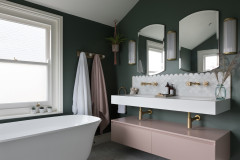
Saima Siddique recommends a wall-mounted unit. “As well as leaving the floor space free, it creates the optical illusion of a bigger bathroom,” she says.
“A wall-hung unit will be smaller than its floorstanding equivalent, so will feel lighter,” Jane Ive says. “It can also be styled and streamlined to look like part of the wall, rather than a standalone item.
“Many people think they have to have a floorstanding unit if the pipes go into the floor,” she says, “but these can be neatly boxed and tiled in below – you don’t necessarily see them unless you get down on your hands and knees.”
“Floorstanding would work better if there are any concerns about the strength of the wall,” Cat Hoad says. “Usually, a contractor would look to fix a wall-hung unit to a solid wall or a stud in a plasterboard wall.”
If you do go for a floorstanding cabinet, she advises, make sure the floor you’re placing it on is level, and that there’s no risk of warping from significant splashing at the bottom of the legs.