
5 Surprising Things You Should Leave in Your Garden
Reduce waste while creating a sustainable, resilient garden with these creative ways to reuse discarded items

Old logs, woody prunings, rubble, weeds and plastic pots can all mount up in a garden, but before you plan a trip to the recycling centre, how about rethinking what you consider to be rubbish? At 2023’s RHS garden shows there were plenty of ideas for reassessing ‘waste materials’ and instead using them to build a beautiful, eco-friendly space for both humans and wildlife to enjoy.
2. Branches and twigs
As well as the logs of fallen trees, you can also utilise the branches and twigs from trees and shrubs you’ve pruned. One way to use these woody cuttings is by forming them into a ‘dead hedge’, as showcased by RHS Wisley at Hampton Court Palace this year (pictured).
Layered birch brush was woven into a circular enclosure with a hedgehog tunnel at the bottom and some decorative nooks of mixed materials. The team says these natural fences provide a shelter for wildlife such as “wasp beetles, newts, banded snails, glow worm beetles, wrens, song thrushes and hedgehogs”.
Find and contact garden designers in your area through Houzz.
As well as the logs of fallen trees, you can also utilise the branches and twigs from trees and shrubs you’ve pruned. One way to use these woody cuttings is by forming them into a ‘dead hedge’, as showcased by RHS Wisley at Hampton Court Palace this year (pictured).
Layered birch brush was woven into a circular enclosure with a hedgehog tunnel at the bottom and some decorative nooks of mixed materials. The team says these natural fences provide a shelter for wildlife such as “wasp beetles, newts, banded snails, glow worm beetles, wrens, song thrushes and hedgehogs”.
Find and contact garden designers in your area through Houzz.
3. Weeds
Instead of spending hours filling a garden waste bag with weeds, you could rethink how you feel about these unloved plants that thrive in our gardens.
This was certainly the message at the RHS garden shows this year, with the Chelsea Flower Show renaming weeds “hero plants”. A third of the show gardens at the event incorporated plants we’d usually refer to as weeds, including Cleve West’s Centrepoint Garden (pictured), which featured plants such as dandelions, cleavers and herb robert.
Cleve said this was an experiment “to see whether a mix of ornamentals and so-called ‘weeds’ can cohabit in an aesthetically pleasing way”.
Instead of spending hours filling a garden waste bag with weeds, you could rethink how you feel about these unloved plants that thrive in our gardens.
This was certainly the message at the RHS garden shows this year, with the Chelsea Flower Show renaming weeds “hero plants”. A third of the show gardens at the event incorporated plants we’d usually refer to as weeds, including Cleve West’s Centrepoint Garden (pictured), which featured plants such as dandelions, cleavers and herb robert.
Cleve said this was an experiment “to see whether a mix of ornamentals and so-called ‘weeds’ can cohabit in an aesthetically pleasing way”.
4. Rubble
If you’ve ever moved into a new home only to find the garden borders full of rubble and bricks, it turns out you might not need to hire a skip to get rid of all that building waste. There were plenty of examples of plants growing within rubble at 2023’s garden shows, as designers sought to demonstrate how to rewild urban areas by working with the substrate that already exists.
At the Chelsea Flower Show, for example, Jon Davies and Steve Williams used rubble as a planting medium in their Centre for Mental Health’s The Balance Garden, as did Kate Bradbury and Jo Thompson in the RHS Wildlife Garden they designed for Hampton Court (pictured).
“You’d be amazed how well rubble will support many woody plants,” RHS Chief Horticulturist Guy Barter said on the organisation’s website. “They won’t grow as fast as in rich soil, but the poor nutrient value and good drainage is highly suitable for Mediterranean plants.”
More: Meet the Designers Championing Sustainable ‘Brownfield’ Gardens
If you’ve ever moved into a new home only to find the garden borders full of rubble and bricks, it turns out you might not need to hire a skip to get rid of all that building waste. There were plenty of examples of plants growing within rubble at 2023’s garden shows, as designers sought to demonstrate how to rewild urban areas by working with the substrate that already exists.
At the Chelsea Flower Show, for example, Jon Davies and Steve Williams used rubble as a planting medium in their Centre for Mental Health’s The Balance Garden, as did Kate Bradbury and Jo Thompson in the RHS Wildlife Garden they designed for Hampton Court (pictured).
“You’d be amazed how well rubble will support many woody plants,” RHS Chief Horticulturist Guy Barter said on the organisation’s website. “They won’t grow as fast as in rich soil, but the poor nutrient value and good drainage is highly suitable for Mediterranean plants.”
More: Meet the Designers Championing Sustainable ‘Brownfield’ Gardens
5. Plant pots
A trip to the garden centre invariably ends with the arrival of a new plastic plant pot to add to your no doubt burgeoning collection. It’s possible to recycle non-black pots at most recycling centres, but the black variety are trickier to discard without putting them into landfill. Some garden centres have set up recycling schemes for plastic pots, but not all.
To avoid them being thrown into household rubbish, Hana Leonard presented a few creative ways to turn these unwanted items into attractive garden features in her Plastic Fantastic garden at the Hampton Court Palace show. Try fashioning them into plastic flowers and attaching them to fences and walls for a cute display, or hang them up high as shades for outdoor lamps.
Alternatively, stack them within a wire frame to create a fence, then plant up the top pot to create a soft, billowy effect along a boundary (pictured).
Tell us…
Do you have any more ideas for using discarded materials in your garden? Share your tips in the Comments.
A trip to the garden centre invariably ends with the arrival of a new plastic plant pot to add to your no doubt burgeoning collection. It’s possible to recycle non-black pots at most recycling centres, but the black variety are trickier to discard without putting them into landfill. Some garden centres have set up recycling schemes for plastic pots, but not all.
To avoid them being thrown into household rubbish, Hana Leonard presented a few creative ways to turn these unwanted items into attractive garden features in her Plastic Fantastic garden at the Hampton Court Palace show. Try fashioning them into plastic flowers and attaching them to fences and walls for a cute display, or hang them up high as shades for outdoor lamps.
Alternatively, stack them within a wire frame to create a fence, then plant up the top pot to create a soft, billowy effect along a boundary (pictured).
Tell us…
Do you have any more ideas for using discarded materials in your garden? Share your tips in the Comments.

Sponsored
Reload the page to not see this specific ad anymore
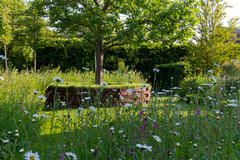
If a tree has fallen or been cut down in your garden, don’t rush to get rid of the logs. Dead wood not only provides a fantastic habitat for wildlife, it can also be used as a raised bed.
At 2023’s Hampton Court Palace Garden Festival, designer Zoe Claymore planted perennials in some rotted logs for her The Wildlife Trusts: Renters’ Retreat show garden (pictured). The result was similar to a permaculture technique known as a hügelkultur mound, where dead wood is used to create a raised bed.
Decaying wood is much better at retaining moisture than soil and provides plenty of nutrients for plants, so it’s a great way to ensure your garden is resilient during periods of drought.