


Recent Activity

The pine is open grown and limbed up about 10'. I've also done some pruning to allow more sun to reach the site. Where it would be planted receives roughly 5-hours of angled sun, so I think that would be sufficient to grow 'Golden Glow'. This area is also irrigated, with a sprinkler head about 8' from where it would be planted. Gardengal, I believe you've convinced me to proceed. :)
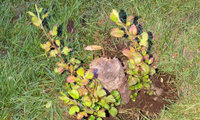

What is currently growing from the stump is whatever pear the rootstock is. If by "cloning" you mean removing the new growth and replanting it to generate a new tree down the road, then yes, it is possible.
But I seem to recall this pear tree is a ornamental, aka callery pear, so generating any new ones by any method is not advised.

I think we established before that this is an ornamental Callery pear so it is probably not grafted, in which case basal shoots will give you genetically identical plants to the parent.
ETA GG's reply wasn't visible when I posted. Hence the repetition.
It is Pyrus communis bosc.

I’d describe the band Chicago as somewhere between Kansas and Boston.
tj
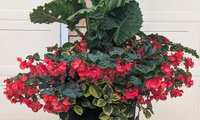
'gg', I think about you lots and your health issues this season. We are all hoping you will be able to do your gardening magic again in 2027.
Thanks of course @lisaam. With no more in ground space I have grown to love doing containers.
“Seem to be a smaller denser version of Hortsmann Silberlocke.”
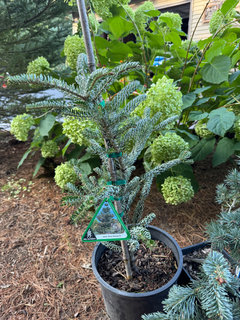
That’s not surprising since it originated from a seedling of ’Horstmann’s Silberlocke’. ’Icebreaker’ was also found as a mutation on ’Horstmann’s Silberlocke’. Of these two, ’Silver Show’ will be closer in size and growth rate to Silberlocke.
There’s no right or wrong to planting a larger size, but there is a real sense of satisfaction seeing a small plant slowly make itself into a nice specimen.
I am fond of all Korean Firs and have several in my garden. Here’s the species:
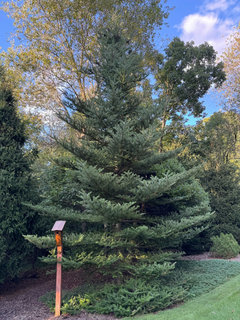
Horstmann’s Silberlocke:
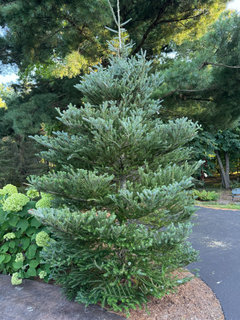
Icebreaker #1:
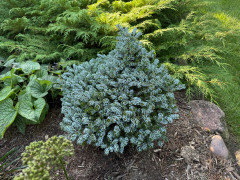
Icebreaker #2:
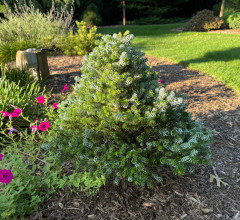
Silver Show: (3gal. yet to be planted)
My favorite is a chopped apple sheet cake. With raisins and walnuts and warm fall spices, it's great with a cream cheese frosting (not too much!). I like baked apples too but they have to be the right kind of apple. I make apple crisp all year round so that doesn't count :-))

I like nearly any of the apple desserts, from apple upside down cake to a sheet cake to pie. I also like Waldorf salad and will have to try that salad of Chloebud's, I have lettuce in my little greenhouse and I like anything with maple in it, yum. I also have about a dozen pears in my refrigerator that are at their peak, that would be good too, and healthier than a Maple Pear Cobbler, LOL.
My favorite way to have apples, though, is to saute them with a little butter and brown sugar and eat them on hot biscuits.
Annie

Annie, those sauteed apples are also great with roasted or grilled pork.😋


This would be fun to try! Made me smile.....the things people come up with!
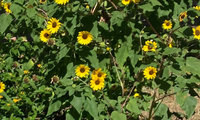
Yes. Most likely Helianthus tuberosus, akaJerusalem artichoke. An aggressively spreading perennial sunflower, it produces edible tubers.
There are many species of sunflowers and not all of them produce those big seedheads and fat, tasty seeds
So I guess some varieties of sunflowers produce small seed pods with seeds that size?
There are many species of sunflowers and not all of them produce those big seedheads and fat, tasty seeds.
"spread somewhat invasively year after year" is what made me guess Helianthus tuberosus. It is a serious spreader/invasive and being perennial, returns year after year.
Both H. tuberosus and H. annuus share a very similar appearance so easily visually mistaken for each other.

I think it's Helianthus anuus. The leaves seem loi large for H. tuberosum. It's annual so it only apprears to be agressive because without deadheading they will be all over the place. The First Peoples to enter the continent selectively bred this annual species of sunflower to produce larger seeds over a period of hundreds or thousands of years. Technically speaking I would say any species in the genus Helianthus is a sunflower. Many other genera in the sunflower family Asteraceae which have yellow ray petals and disk flowers are also called some type of sunflower in their common names. The name Helianthus comes from helios meaning sun, and anthos meaning flower. Sun+flower. You can check the involucre to verify.
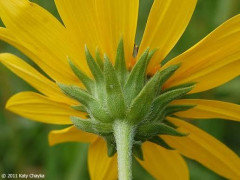
Heianthus tuberosa , Jerusalem Artichoke
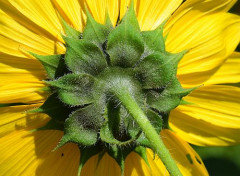
Helianthus anuus, Annual Sunflower.

Sad to admit - I can't sing. But if I were home alone and had the music turned up loud it would be rock - Joan Jett's I Love Rock and Roll, Bob Seger's Old Time Rock and Roll, or anything by Queen.
I think what the great minds of the world need to do is, (1) continue to develop processes that completely break down plastics, some of the work with micro-organisms is interesting, (2) continue to develop fully biodegradable forms of plastic, and (3) when #2 can be scaled cost-effectively, pass laws that ban the use of non-biodegradable plastics with exceptions for situations when a viable biodegradable alternative is not available or not advisable.
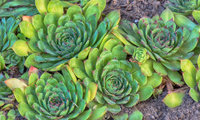
The Common Houseleek, Sempervivum tectorum, is very hardy. I don't think there's any reason to think these are anything else.
The only sterile (non-berry producing) form of ligustrum is L. sinensis 'Sunshine'. The only other reason a ligustrum would not produce berries is lack of pollination. As these are primarily insect pollinated, weather could very well have an impact on that.
'Sunshine' ligustrum has bright yellow leaves and doesn't flower at all. To my knowledge, it is the ONLY sterile form of ligustrum.

Photos might help. Does the fruiting plant's foliage look the same as those that aren't fruiting?
The patch is a mile or two away, so I can't run out and get a photo. But all the foliage looks the same for all the trees. What was striking was that in this one stand, there was just a foot or two of branches with berries.
Sunset at 7:40 here and creeping earlier :-) Not fully dark till after 8-ish.
Our weather in the PNW is typically always mild and this summer has been no exception. Not particularly hot and with our usual summer dryness. The seasons tend to flow gradually into each other and while I can feel a hint of fall in the air, it is not obviously here.....yet.
Fall is my favorite time of year - fall color, cooler temps (no need for fans or AC), harvest time, late season flowers, Halloween, my birthday, cozy food, cozy clothes. I like it all!
Im at Sandridge beach in va with my daughter and her family. The weather is perfect for the beach and for just enjoying the deck with a great view of the ocean. It really cools down at night which is nice. I am looking forward to fall and all that comes with it. Taking a cruise to Canada in October and hoping the leaves with be colorful.

I was surprised hiking the trail today and noticing many fallen leaves. I think that's a little early.
First, there is an entire forum that discusses all these issues in detail. You might find that helpful. https://www.gardenweb.com/discussions/soil
Second, gardeners have differing opinions as to whether compost should be applied over bark, under bark or mixed with bark and incorporated into the soil. Your choice - no right or wrong.
Finally, it is suggested that mulch/compost not cover the crown of perennials. Otherwise, you want to avoid digging mulch or compost into the root system.
That's a good question. I really don't know the technical answer, but I'd probably rake back the mulch and put teh compost right onto the soil, unless the bark has decomposed to the extent that there's little left.
Agree with GG -- keep the compost and the mulch off the crowns.
Ditto. I would pull back the bark mulch, put the compost onto the soil, and replace the bark mulch. And yes, keep the mulch off the crowns.
:)
Dee

According to the Hardy Fern Foundation, Doodia media is hardy to zone 8a. If an unusual cold snap is predicted, they do suggest covering.
https://hardyferns.org/ferns/doodia-media/
I am going to replace it with a Japanese painted fern.


Since there is no legal requirement for the name change, maybe the swing in popularity will cause the more used apps to revert to the proper names for geographic locations....not those made up by some sharpie-wielding man-baby.
I was going to post a time traveling joke but you guys didn't like it.
tj
"Euonymus alatus is regarded as an invasive species of woodlands in the northeastern United States and southeastern Canada, where it can outcompete native vegetation and disrupt local ecosystems. It is currently, since the 1970s, considered an invasive species in 21 U.S. states, and its importation and sale are prohibited in the U.S. states of Maine, Massachusetts, New Hampshire, Pennsylvania, and Vermont."
"It grows in partial shade to full sun in woodland edges, forests, mixed deciduous forests, on roadsides, disturbed areas and any open area where it may expand into a dense grove. It is a prolific seeder and may also reproduce by stem cutting.
The spring flowers are insignificant, but the red fall berries are showy and are consumed by birds and deer, which helps the plant spread beyond cultivated garden areas. Aggressive growth enables it to outcompete other plants. Aggressive growth enables it to outcompete other plants. Its invasive tendency has been noted in multiple midwestern and eastern states from Connecticut to South Carolina and west to Wisconsin.
To control small infestations of burning bush, pull up young plants by hand and use a hoe or root-wrenching tool for large plants. For larger infestations, an herbicide can be applied to the foliage or the stump immediately upon cutting."
NRCS Invasive Plant Control Burning Bush – Euonymous alatus: https://efotg.sc.egov.usda.gov/api/CPSFile/21638/314_VT_OTH_Brush_Management-Burning_Bush_

ONE IDIOT in this neighborhood planted one about 16 years ago - and now I see them starting to pop up in the hedgerows adjacent my property. They are more of a 'northern' shrub and used not to be common in this part of Maryland. (by contrast, several gardens have invasive Nandinas, but I don't see those spreading as much. One family recently removed their Nandina hedge though, maybe because it was seeding in their garden.) Please delete this from your garden!
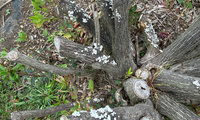
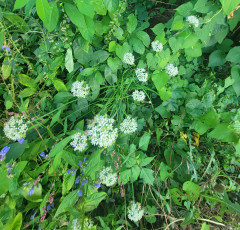
Meanwhile ;-), those white things remain fungal fruiting bodies, most likely Schizophyllum commune.
Yes. Moving from one pot to another is a repot. Lifting, refreshing/adding to the potting soil and replacing in the same pot is also a repot. You have just skipped any root pruning, which may or may not be considered part of a repot, depending on the circumstances.
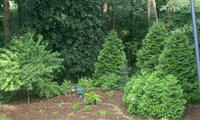
Shade and moist soils are ideal for mophead hydrangeas......not so much for panicles. They prefer sunnier and typically drier situations. Just restrict the pruning of mopheads to deadheading the old flowers, as pruning can eliminate flowering. You may also need some protection from extreme winter cold or late spring frosts, as cold temps can also inhibit flowering.
Japanese snowbell trees are lovely but will get much larger than the one in your photo.
Thank you!

Oops, I did not research Dead Nettle. I'm in California and not familiar with Zone 7b plants.
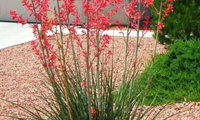

@outpaientzero - You’re correct that she is using a different account but you’re incorrect that all her posting history is all gone. If there are ongoing safety concerns from that incident as you seem to be alleging, then maybe the better thing would be not to bring the situation back into the spotlight.
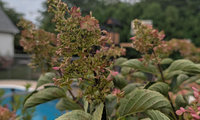
Maybe they are not getting as much water as you think? Since I am not there, I can't tell what rainfall, irrigation practices or soil conditions are or if extended high temperatures have been present but both the leaves and flowers show a very clear dryness or lack of water.
Test the soil moisture at a depth of 4 inches frequently when above 85F or if in a drought. As soon as it is dry, irrigate the soil directly (not the leaves nor the blooms) and deeply. Deeply means the soil should feel moist at a depth of about 8 inches after you irrigate and the water percolates down. If you irrigate and the soil is not moist at a depth of around 8 inches then you did not irrigate sufficiently. Maintain 3-4" or organic mulch up to the drip line so you can always keep the soil at a depth of 4" evenly moist.

An old farmer writes to his son in prison: "Dear son, this year I won't be able to plant potatoes because I can't dig the field by myself. I know if you were here you would help me!"
The son writes back: "Dad, don't even think of digging the field because that's where I buried the money I stole!"
The police read the letter and the next day the whole field is dug up by police looking for the money, but nothing is found.
The following day the son writes again: "Now plant your potatoes, Dad. It's the best I can do from here!"
I would agree with Malva sylvestris. IME, it can self-seed prolifically in areas where it is happy growing.
Susy Jackson, how do you like your Callirhoe bushii? I keep mine on a short leash. I just got seeds for clustered Poppy Mallow, Callirhoe triangulatum. My Malva zebrina lasted a long time. The seeds must stay viable for a long time? Abelmoschus manihot is similar. I have an Abelmoschus vollunteer now. I like Malva alcea and it's the species I'd grow if I grew Malva again. Unfortunately my climate is too cold for a serious Flowering Maple obsession. I don't need tropicals to be happy and content.
Thanks all. Does Malva sylvestris spread from the roots? I've not noticed it doing so but this is the first time I've had it in my garden.
For what its worth, I've lived in Cascadia for more than 20 years now and dozens of aggressive species of garden plants have tried to invade my (six) gardens.....but not Malva sylvestris, which I had to invite! We will see how this plays out.
I wonder if it has been decided to keep clocks unchanged later this fall?
Daylight saving time in the United States begins at 2:00 a.m. on the second Sunday of March (at 2 a.m. the local time time skips ahead to 3 a.m. so there is one less hour in that day and ends at 2:00 a.m. on the first Sunday of November (at 2 a.m. the local time becomes 1 a.m. and that hour is repeated, so there is an extra hour in that day)

I messed up. I started talking to the dog already this morning. Rats!
I remembered and have all summer, and so far it hasn't worked.
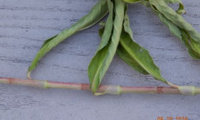
But not bamboo most importantly.
Not necessarily. 😁 The possibility of something far more sinister than bamboo exists and does have the ability to pop up spotaneously, which bamboo does not. I agree it is likely to be something in the Polygonaceae (Fallopia, Bistorta, Persicaria, Polygonum, Reynoutria, etc), but not clear enough to nail down a particular species. Besides, they seem to change names every few weeks anyway!!
At least your mystery plant does not appear to be one of the really bad guys of the family, Reynoutria or the giant knotweeds. Those are serious invaders and are far more difficult to control than any bamboo.
I just want to clarify that there's only 1 species of Persicaria that has been considered to be placed into a seperate genus. It's Virginia Jumpseed aka Woodland Knotweed, Pericaria virginiana. Virginia Jumpseed has a long flower stem with the flowers seperately spaced out, while the other Persicaria,(Smartweeds) have a much shorter flower stems and the flowers are held together in s tight cluster. Persicaria virginiana has an Asian lookalike named Persicaria filiformis. Filiformis has red flowers and is sold in the trade. The danger is that it can be easily confused with our native jumpseed.
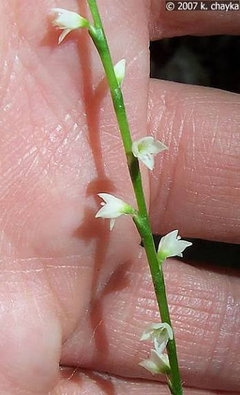
Virginia Jumpseed
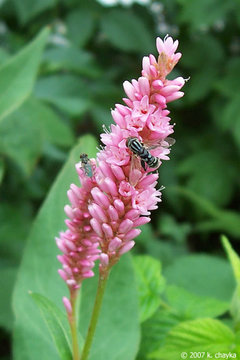
Pennsylvania Smartweed
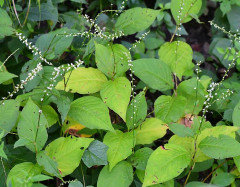
Virginia Jumpseed
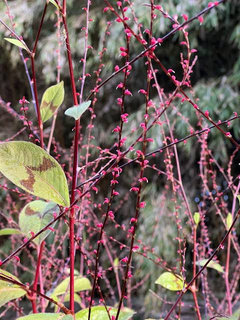
Asian Jumpseed, Persicaria filiformis
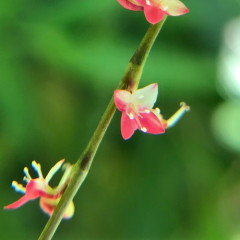
Asian Jumpseed

Elmer, I have no interest in reading Maria DiLorenzo's book. That's not my genre. I mentioned her and her book because KW PNW asked if I'd been to a popular bookstore here. I responded to her acknowledging I had, and while I was there, I listened to an author speak. I like true crime shows or podcasts, but true crime books aren't my thing. I could have purchased her book for half price and had her sign it but passed on that.
I especially won't be reading it given its low reviews. Listening to the author speak was interesting.
I mentioned on post several weeks ago that my neice and her DH have an independent book store (actually 2 of them) in NYC
My niece and her DH met each other in a book club. They each had their own successful careers but dreamed of owning an independent book store.
After month and months of research and work they opened their store in Nov. 2019. It is called Book Club Bar at 197 East 3rd Street in NYC.
Several family members thought they were crazy to do so try and open an independent book store and that was before Covid became a factor and getting their liquor license took months. They persevered with their dream and 6 plus years later they are going strong and have opened a second location at 380 Troutman St, Brooklyn, NY 11237.
In addition to books and beverages they have numerous events scheduled throughout the months such as: Meet the Author/Book Launches, Literary Trivia, Creative Writing Workshops, Various Book Club in person Discussion Groups, Adult Spelling Bees, etc, etc.
The Book Club Bar is a book store and much more. Check it out if you are in NYC.
@ gardengal48 (PNW Z8/9), I definitely will let you know! I love Eagle Harbor Books, great bookstore. I'm thinking about some day this coming week or the following week.
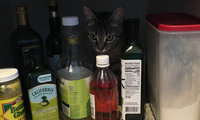
Our late beloved Katya looked a lot like Pookie, same colouring and markings. She was as smart as a whip. One day I found her sitting in the laundry sink, with a trickling noise. I wondered what was going on until I spotted her sister Nadia in the litter tray, which is in the laundry. Clearly Katy couldn't wait, so she was peeing down the drain in the sink!
We have a flat in the city, where DH stayed during the work week before he retired. Now we stay there when we want a city break. We'd take the cats with us. If they got frightened by loud noises or whatever, they would dash into the kitchen, open the undercounter cupboards and get in to hide in the back corner. Nadia still does that.
Nadia's latest trick is taking her thyroid medication. Recently she was diagnosed with having a thyroid condition, which had caused her to lose a lot of weight. We opted for a liquid medication rather than a pill, as easier to administer. At first, when Nadia saw me holding the syringe, she'd start sneaking away, resulting in a slow chase around the house until I caught her and held her while I gave her the medication. Now, when she sees me at the counter where I fill the syringe, she will come up to me and meow until I bend over to give her the medication, and opens her mouth for me to squirt it in. I am amazed!
My new-ish dog, Lacey, has some cute quirks. She does a "happy paws" begging when she is hungry. She also sits in an odd manor which I have learned is a poodle thing and she also has her tongue out when she is sleeping.



She has a lot of personality and makes me laugh every day.

Hardy hibiscus, sure! Rose of Sharon and Rose mallow are popular here. Tropical hibiscus, Hibiscus rosa-sinensis, is not winter hardy here but is sometimes grown as a houseplant.
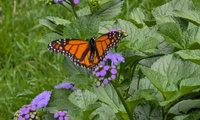
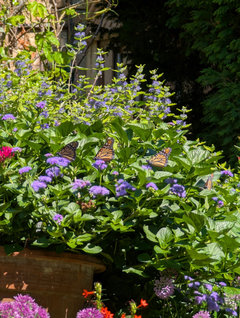
Hey @ruth_mi, can you see 4 monarchs "lined up" on this ageratum?

Looks like a very compact form of Wand Flower, Oenothera lindheimeri 'Siskiyou Pink' (formerly Gaura lindheimeri),
OK. Botanically perennial, to be more precise.
Thanks, all! I quite like it. Had three big flushes of pretty blossoms, so basically constant blossoms.
maackia - I've never seen the tree in Portland or discussed it with local gardeners. Cistus says it should be no problem here, but of course they would. Since my tree is growing for the second time now in September, I would say its probably a pretty quick grower. Probably 25' in gardens, 80 plus feet in native range.
While giving a tour of "Rancho Cistus" earlier this year, Sean Hogan said "we're very lucky to live in a place where anything will grow, whether it likes water or not. For those types that need regular water, just add it and stand back!".
"we're very lucky to live in a place where anything will grow, whether it likes water or not. For those types that need regular water, just add it and stand back!".
I'd have to agree with that :)) A fellow horticulturist once told me the reason his plants grew so fast and so large is that he gave them plenty of water. I've experienced similar - water lavishly (with decent drainage) and plants will grow rapidly and lushly.
btw, I have never heard of Machilus thunbergii although I've a passion for less common BLE's. Everyday I discover more about plants and gardening........ even after all these many years.